

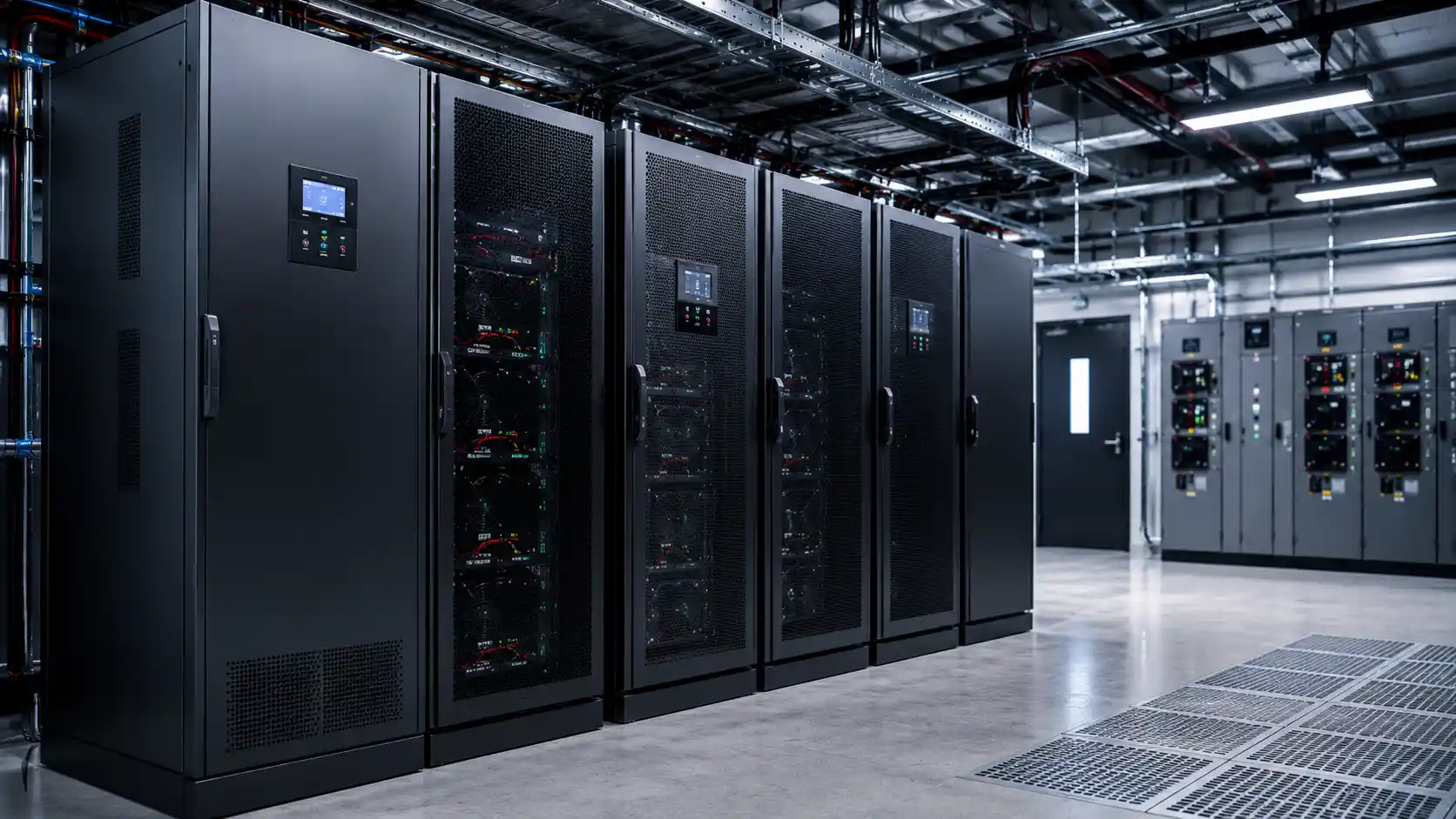
UPS Systems Explained: Ensuring Continuous Power for Mission-Critical Facilities
Every organization that depends on continuous operations has one fundamental vulnerability: the power grid. Despite significant improvements in grid reliability over the decades, power outages, voltage fluctuations, and power quality disturbances remain a constant threat to mission-critical facilities. For data centers, hospitals, government installations, financial institutions, and industrial operations, even a brief power interruption can trigger cascading failures with serious operational, financial, and safety consequences.
Uninterruptible power systems are the cornerstone of reliable power infrastructure for mission-critical facilities. They provide immediate, seamless backup power during outages, protect sensitive equipment from power quality disturbances, and give facility operators the time needed to execute controlled responses to power events. Understanding how UPS systems work, what types are available, and how to select and maintain the right system for your facility is essential knowledge for any organization where downtime is not an option.
What Is an Uninterruptible Power System
An uninterruptible power system is an electrical device that provides continuous, conditioned power to connected loads by maintaining an internal energy reserve, typically in the form of battery banks, that can instantly supply power when the primary utility source fails or degrades below acceptable levels.
Unlike a backup generator, which takes several seconds to start and reach stable output, a UPS system responds to power failures in milliseconds. This instantaneous response is critical for sensitive electronic equipment that cannot tolerate even the briefest interruption in power supply. In most modern UPS systems, the switchover from utility to battery power is so fast that connected equipment does not register any interruption at all.
Beyond outage protection, UPS systems also perform an important power conditioning function. They filter out voltage surges, sags, spikes, harmonic distortion, and frequency variations that can damage sensitive equipment and degrade performance over time. For facilities running high-value computing hardware, medical equipment, or precision industrial systems, clean and stable power is just as important as continuous power.
How UPS Systems Work
While different UPS topologies operate in slightly different ways, the fundamental operating principle is consistent. The UPS system continuously monitors incoming utility power for deviations from acceptable voltage and frequency parameters. When utility power is within acceptable range, the UPS supplies conditioned power to connected loads while simultaneously maintaining its battery banks at full charge.
When the UPS detects a power failure or unacceptable power quality condition, it instantly switches to battery power, continuing to supply clean, stable power to connected loads without interruption. The battery banks supply power until either utility power is restored and the UPS switches back, or the battery banks are depleted and a controlled shutdown must be initiated.
In online double conversion UPS systems, which are the preferred topology for most mission-critical applications, the connected loads are always powered from the inverter rather than directly from the utility. Incoming AC power is converted to DC to charge the batteries, and then converted back to AC to power the loads. This means that connected loads are completely isolated from utility power quality issues at all times, providing the highest level of power protection available.
Types of UPS Systems
Offline or Standby UPS
The simplest and most affordable UPS topology. In normal operation, loads are powered directly from utility power. The UPS switches to battery only when a failure is detected. This topology provides basic outage protection but offers limited power conditioning and a brief switchover time that may not be acceptable for sensitive equipment.
Line Interactive UPS
A more capable topology that includes an automatic voltage regulator to handle voltage fluctuations without switching to the battery. Suitable for environments with frequent voltage variations but less severe power quality issues. Offers better power conditioning than offline systems with shorter switchover times.
Online Double Conversion UPS
The gold standard for mission-critical applications. Loads are always powered from the inverter, providing complete isolation from utility power quality issues and zero transfer time during outages. This topology is the preferred choice for data centers, hospitals, financial institutions, and other facilities where any power quality compromise is unacceptable.
Modular UPS Systems
A scalable approach to UPS design where individual power modules can be added or removed to match changing load requirements. Modular systems offer high flexibility, simplified maintenance, and built-in redundancy, making them increasingly popular for growing data centers and AI factories.
UPS System Sizing and Design Considerations
Selecting the right UPS system for a mission-critical facility requires careful engineering analysis covering several key factors.
Load capacity is the most fundamental consideration. The UPS system must be sized to handle the total connected load with sufficient headroom for future growth. Undersized UPS systems are a common cause of failures in facilities that have expanded their operations without upgrading their power infrastructure.
Redundancy configuration determines how the facility will respond to a UPS system failure. Common redundancy approaches include N+1 configurations where one additional UPS module is available to take over if another fails, and 2N configurations where a complete parallel UPS system is maintained as a backup.
Battery bank sizing determines how long the UPS system can support the connected load during an outage. Battery runtime requirements depend on how long the facility needs to operate on battery power before either utility power is restored or backup generators come online.
Physical environment factors including temperature, humidity, and available space also influence UPS system selection. UPS systems and battery banks have specific operating temperature requirements, and facilities in challenging climatic environments such as those served by CPS Group in the Caribbean and Latin America must account for these factors in their infrastructure design.
The Importance of UPS Maintenance
Even the most sophisticated UPS system will eventually fail without regular preventative maintenance. Battery degradation is the most common cause of UPS system failures. Batteries age and lose capacity over time, and individual cells can fail without any visible warning signs. Regular battery testing including voltage, impedance, and capacity testing is essential to identify weak or failing batteries before they compromise the entire system.
Beyond battery maintenance, UPS systems require regular inspection of capacitors, fans, connections, and other components that degrade over time. Thermal imaging can identify developing hotspots in electrical connections before they cause failures. Load bank testing validates that the complete UPS system and battery bank can perform under real demand conditions.
A comprehensive UPS maintenance program delivered by OEM-authorized engineers ensures that your uninterruptible power systems remain reliable, compliant, and ready to perform when your operations depend on them most.
How CPS Group Supports Mission-Critical UPS Infrastructure
Critical Power Solutions Group, Inc. is an OEM-authorized provider of UPS system design, installation, commissioning, and maintenance services for mission-critical facilities across the United States, Caribbean, and Latin America. Recognized by Inc. 5000 as one of America’s fastest-growing companies and by Goldman Sachs 10,000 Small Businesses, CPS Group brings certified engineering expertise and deep OEM knowledge to every UPS project.
We design and install industrial UPS systems from leading OEM partners including ABB, APC, Eaton, GE, Fuji Electric, and Ortea, customized to the specific load requirements, redundancy needs, and operational environments of our clients. Our certified field engineers provide comprehensive preventative maintenance programs, battery testing and replacement services, load bank testing, and 24/7 emergency response to keep your UPS systems performing at peak.
Whether you are designing a new UPS infrastructure for a data center or AI factory, upgrading aging systems in a healthcare facility, or maintaining mission-critical UPS equipment for a government installation, CPS Group delivers the reliability, expertise, and accountability your operations demand.
Conclusion
Uninterruptible power systems are not simply a backup precaution for mission-critical facilities. They are a fundamental component of reliable power infrastructure that protects operations, equipment, data, and people from the inevitable disruptions of an imperfect power grid. Understanding how UPS systems work, selecting the right topology and configuration for your facility, and maintaining your systems through regular preventative maintenance are the foundations of a resilient power strategy.
For organizations where continuous operations are non-negotiable, investing in properly engineered, regularly maintained UPS infrastructure is one of the most important decisions you can make.
Contact CPS Group today to speak with our OEM-authorized engineers about designing, installing, or maintaining the right UPS solution for your mission-critical facility.