

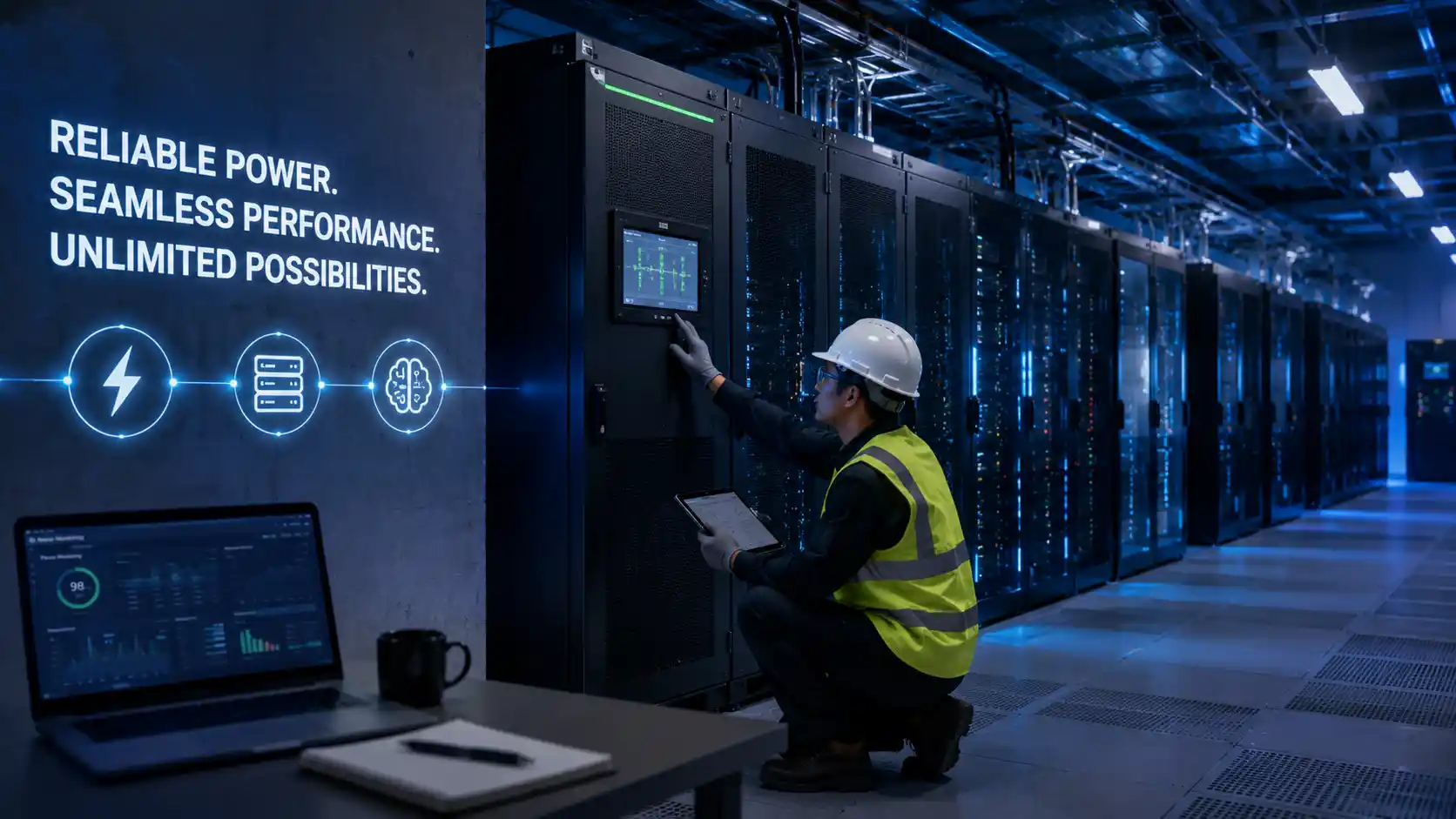
Why Reliable Power Infrastructure Is Critical for Data Centers and AI Operations
Why Reliable Power Infrastructure Is Critical for Data Centers and AI Operations
Data centers and AI factories are the backbone of the modern digital economy. From cloud computing and financial transactions to medical records and artificial intelligence workloads, these facilities process and store information that the world depends on every second of every day. Behind every server rack, storage array, and GPU cluster is one non-negotiable requirement: reliable, uninterrupted power.
Power infrastructure is not a background consideration for data centers and AI operations. It is the foundation everything else is built on. When power fails, operations fail. And in today’s high-stakes digital environment, even a few minutes of downtime can translate into millions of dollars in losses, damaged reputations, and compromised data.
What Makes Data Centers and AI Factories Different
Traditional commercial facilities can tolerate brief power interruptions with minimal consequences. Data centers and AI factories cannot. These environments operate at massive scale with thousands of interdependent systems running simultaneously. A single power disruption can corrupt active workloads, damage sensitive hardware, trigger cascading system failures, and result in significant financial and reputational damage.
AI operations add another layer of complexity. Training large language models, running inference workloads, and processing real-time data requires enormous, sustained power draw. GPU clusters and high-performance computing systems are particularly sensitive to power quality issues including voltage sags, harmonic distortion, and frequency variations. These power quality problems can degrade performance, shorten equipment lifespan, and in some cases cause permanent hardware damage.
This is why the power infrastructure supporting data centers and AI factories must be engineered to a higher standard than virtually any other type of facility.
The Role of UPS Systems in Data Center Power Protection
Uninterruptible power systems are the first and most critical line of defense for data centers and AI operations. A properly engineered UPS system provides immediate, seamless backup power during outages, protecting active workloads and giving facility operators time to bring backup generators online or execute controlled shutdowns.
Modern data centers typically deploy UPS systems in redundant configurations such as N+1 or 2N to eliminate single points of failure. This means that if one UPS system fails or requires maintenance, another immediately takes over without any interruption to operations.
Beyond outage protection, UPS systems also condition power quality by filtering out voltage fluctuations, surges, sags, and harmonic distortion. For AI factories running sensitive GPU hardware, clean, stable power is just as important as continuous power. Poor power quality degrades performance and accelerates hardware wear, increasing total cost of ownership over time.
Industrial UPS systems for large data centers and AI factories are typically three-phase systems capable of supporting loads ranging from tens of kilowatts to several megawatts. Selecting the right UPS system requires careful load analysis, redundancy planning, battery bank sizing, and integration with the facility’s overall power distribution architecture.
Battery Banks and Backup Power for Extended Outages
UPS systems provide short-term backup power, typically ranging from minutes to around thirty minutes depending on battery bank size and load. For extended outages, data centers and AI operations rely on backup generators to maintain continuous operations.
The transition from utility power to generator power must be seamless. Automatic transfer switches detect power failures and trigger the generator start sequence, with the UPS system bridging the gap during the few seconds it takes for the generator to reach operating speed and stabilize output. A properly engineered backup power system ensures this transition happens without any interruption to critical workloads.
Battery bank sizing is a critical engineering decision. Banks must be large enough to support the full facility load for the required duration while also accounting for battery aging and capacity degradation over time. Regular battery testing including voltage testing, impedance testing, and capacity testing is essential to verify that battery banks will perform as required during a real outage.
Power Distribution and Switchgear in Critical Data Environments
Power distribution infrastructure connects utility feeds, UPS systems, generators, and IT loads into a coherent, reliable system. For data centers and AI factories, this typically includes medium-voltage switchgear at the utility connection point, low-voltage distribution systems feeding UPS and IT loads, power distribution units within server rows, and redundant distribution paths to eliminate single points of failure.
Properly engineered switchgear and distribution systems ensure that power flows reliably from source to load under all operating conditions, including during maintenance activities, equipment failures, and utility disturbances. Automatic transfer switches at multiple points in the distribution architecture provide additional redundancy and flexibility.
Preventative Maintenance for Data Center Power Infrastructure
Even the best-engineered power infrastructure will eventually fail without regular preventative maintenance. Scheduled maintenance programs are essential for data centers and AI facilities to identify and address issues before they cause unplanned downtime.
A comprehensive preventative maintenance program for data center power infrastructure typically includes thermal imaging and infrared scanning to detect heat buildup in electrical connections and equipment, visual and electrical inspections of UPS systems, switchgear, and distribution equipment, battery voltage, impedance, and capacity testing, load bank testing to validate UPS system and generator performance under real conditions, and compliance documentation to meet regulatory and operational standards.
Regular maintenance extends equipment lifespan, reduces the risk of unplanned failures, and ensures that backup power systems will perform reliably when needed. For data centers operating under strict uptime SLAs and AI factories running continuous workloads, preventative maintenance is not optional. It is a fundamental operational requirement.
Why Organizations Trust CPS Group for Data Center Power Infrastructure
Critical Power Solutions Group, Inc. is an OEM-authorized provider of engineered power infrastructure solutions for data centers, AI factories, and mission-critical facilities across the United States, Caribbean, and Latin America. Recognized by Inc. 5000 as one of America’s fastest-growing companies and by Goldman Sachs 10,000 Small Businesses, CPS Group brings certified engineering expertise and OEM-level knowledge to every project.
Our certified field engineers design, install, commission, and maintain UPS systems, battery banks, backup power solutions, power distribution systems, and turnkey infrastructure for organizations where downtime is not an option. We partner with leading OEM brands including ABB, APC, Eaton, GE, Enersys, and Saft to deliver customized solutions built for the demanding environments of modern data centers and AI operations.
From scheduled preventative maintenance programs to 24/7 emergency response, CPS Group supports the full lifecycle of your critical power infrastructure with the reliability, speed, and accountability your operations demand.
Conclusion
Reliable power infrastructure is not a luxury for data centers and AI operations. It is a business-critical requirement. From UPS systems and battery banks to power distribution, switchgear, and backup generators, every component of your power infrastructure must be engineered, maintained, and monitored to the highest standard.
Organizations that invest in properly engineered, regularly maintained power infrastructure protect their operations, their data, their customers, and their bottom line. Those that do not face the very real risk of costly, damaging, and entirely preventable failures.
Contact CPS Group today to learn how our OEM-authorized engineers can design, install, or maintain reliable power infrastructure for your data center or AI factory.